
'It is surprising and unfortunate that unfounded allegations are now being made without any reference to me whatsoever,' Vijay Mallya said.

Dealmakers and advisors feel investors are shifting their focus to Asia Pacific, especially India, owing to geopolitical instability driven by events such as Brexit and protectionist trade wars.


While the most obvious beneficiary of this roll-out will be manufacturers of FASTags, or the Radio Frequency Identification chips, a PwC report says implementation of a pan-India electronic toll collection system on national highways may help save approximately Rs 87,000 crore annually.

Operating systems are increasingly subject to cyberattacks, as many are built around legacy technologies with weaker protocols

The Indian Broadcasting Foundation (IBF) on Monday announced the appointment of former Supreme Court judge Justice Vikramjit Sen as the Chairman of its newly formed self-regulatory body Digital Media Content Regulatory Council (DMCRC).

India's e-commerce sector is expected to touch $22bn in 2015.

USL board said its second forensic audit by EY has revealed fund diversion worth Rs 1,225 cr to Mallya companies.

Payments startup BharatPe on Tuesday said it has terminated several employees and vendors as well as filed criminal cases against them for misconduct besides deciding to claw back former founder Ashneer Grover's restricted shares in the firm. The steps have been taken by the company's board following a detailed corporate governance review against the backdrop of alleged lapses and misdoings during the tenure of Grover as managing director. IPO-hopeful BharatPe, which allows shop owners to make digital payments through QR codes, has implemented a new code of conduct for senior management and employees and brought in a comprehensive vendor procurement policy to avoid a repeat of alleged lapses that happened when Grover was managing director.

Stressed MSME borrowers would be eligible for restructuring of debt, if their accounts were classified standard.

India studied the Malaysian model, which was scrapped on Wednesday, before implementing the GST and borrowed the anti-profiteering clause to ensure GST benefits are passed on to the end-consumer by the industry

PE/VC investments touched a record $11.2 billion in the first half of 2017 against $8 billion in the same period in 2016

Membership of Nuclear Suppliers Group ensures continued availability of fuel sufficient to operate India's nuclear plants.

The initiative is being undertaken by the government of Karnataka, considered one of the leaders in the technology space. Currently, India doesn't have such a platform and, globally, there are very few privately-run platforms.

Between 2007-08 and 2017-18, the number of countries they imported steam coal from has increased from six to 12.

The FMC had warned MCX that it would not renew contracts, allow new contracts and eventually take away the licence to run the bourse if the commodity exchange does not comply with regulatory norms.

In a move to plug gaps in the Insolvency and Bankruptcy Code (IBC), the ministry of corporate affairs (MCA) has proposed robust norms against avoidance transactions, wrongful trading, and inordinate delays via changes to look-back period and fixed timelines for the tribunals to reject or approve plans, among other measures. The MCA has proposed that the IBC should provide the adjudicating authority with 30 days for approving or rejecting a resolution plan under Section 31. If a decision is not made on the resolution plan within that period, the adjudicating authority will record reasons in writing for the same, the ministry has proposed.

The Budget has changed the rules for Indian citizens and persons of Indian origin visiting India. Instead of 182 days, the number of days has been reduced to 120. You will be treated as a resident of India for tax purposes if you stay in the country for more than 120 days in a financial year and 365 days in the past four years. One consequence of the change will be that people of Indian origin who reside outside India will be able to spend a smaller number of days in the country if they wish to keep their non-resident status intact, points out Sanjay Kumar Singh.

'Health will continue to be at the centre of the government's attention as it underpins economic recovery and our collective well being.'

Take out Maruti Suzuki and Honda, and the auto sector's prospects suddenly don't look all that rosy.

Albeit muted for most part of the year, Deal Street in India has clocked M&As worth $29 billion in 2014 and expects the size to get larger with transactions worth over $40 billion in the New Year.

He is the first Indian-origin person to head a 'Big-Four' audit co.

'A bold, progressive step forward,' Kotak Mahindra Bank CEO Uday Kotak said of Nirmala Sitharaman's corporate tax breaks.

The 13 firms under consideration had nearly a million employees as of March 2018, including contractual and temporary workforce.

It's the same sourcing norms that have been a hurdle for multinationals such as Apple Inc in setting up retail operations in India.

"India's middle class, small traders and farmers are the lifelines of its economic growth. By catering to these ambitions #Budget2019 infuses hopes for millions of dreams."

Hindi news channel News Nation TV showed laboratories in the national capital offering commissions as high as 50 per cent to doctors who referred patients to their diagnostic centres.

The Reserve Bank of India (RBI) on Wednesday proposed to make interoperability mandatory for digital payments firms. It also allowed users to withdraw cash from e-wallets and fintech companies to process RTGS and NEFT transactions. The RBI expressed dissatisfaction over prepaid payment instruments' (PPIs') failure to migrate towards full-KYC (know your customer) PPIs, and therefore interoperability, even two years after guidelines were issued.

Goods and Services Tax (GST) collections at Rs 95,480 crore in September touched the highest level so far this fiscal, the finance ministry said on Thursday.

Amid fears of a third wave of coronavirus pandemic and hardening of retail inflation, the Reserve Bank is likely to maintain status quo on interest rate and watch the developing macroeconomic situation for some more time before taking any decisive action on monetary policy. The RBI is scheduled to announce its bi-monthly monetary policy review on August 6 at the end of the three-day meeting -- August 4-6 -- of the Monetary Policy Committee (MPC). The RBI Governor-headed six-member MPC decides on the key policy rates.

Equities in India saw record FPI inflows of $16.8 billion in November and December, taking the benchmark indices to new highs.

Easier dilution norms for mega initial public offerings (IPOs) have come into effect. Companies with post-listing market capitalisation (m-cap) of more than Rs 1 trillion will not be required to dilute a minimum of 10 per cent. The move to relax dilution norms is seen as a precursor to Life Insurance Corporation's IPO. The central government has said companies with an m-cap exceeding Rs 1 trillion will have to dilute Rs 5,000 crore and at least 5 per cent of their m-cap. Experts said the earlier framework discouraged large companies from listing since they were forced to offload a large volume of shares during the time of their IPO.

Last Saturday, USL board asked its Chairman Vijay Mallya to quit.

Since existing laws do not cover Covid-19, any compensation in this regard has to be left to the discretion of companies.

Indians at large harbour a notion that their country is cherrypicking out of the American basket of goodies, but the policymakers in Delhi and the political leadership are well aware that it can only be a pipe dream since a military alliance with a superpower is a profound irrevocable commitment, observes Ambassador M K Bhadrakumar.

India is likely to lose Rs 53,000 crore from its economy as companies are unable to hire people with right talent for the job and are incurring high recruitment costs, says a study.

The survey by consultancy firm PwC, 'Future of Work: A journey to 2022', quizzed 10,000 people across China, India, Germany, the UK and the US on the future of work and what it meant for them. 1,898 of these respondents were from India.

Ninety-nine companies, which also include some unlisted ones, have more than Rs 100 crore each of minimum alternate tax credit on their books, cumulatively adding up to Rs 75,000 crore. By utilising MAT credit, many companies will be able to bring down their effective tax cost.

To begin with, there would be the immediate integration of various technology stacks. This would create more business for global consulting and IT services entities such as KPMG, PwC, EY, Accenture and IBM, among others. Indian service providers - Infosys, Tata Consultancy Services (TCS), and Wipro, for instance - would also cash in.
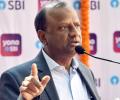
'At the first board meeting I chaired, I sensed that corporate governance is an issue in this company.' 'I started taking steps that may have aggrieved a few.' 'This has now become a mission I intend to accomplish before I step down.'
